
DARTA DIGITAL AUDIO · PHASER PLUGIN

The analog phaser of the 70s pedals, with the stages and the resonance modeled as in the circuit. Four, six or ten stages, swept by the LFO, by your picking or parked in one spot, and a RAMP that speeds up like a rotary speaker.
Charged in Brazilian Reais (BRL), converted from US$ 19 at the day’s exchange rate. PayPal or your card converts it back and shows the exact amount in your currency before you confirm. Download link and license key by e-mail right after payment. Windows and Mac.
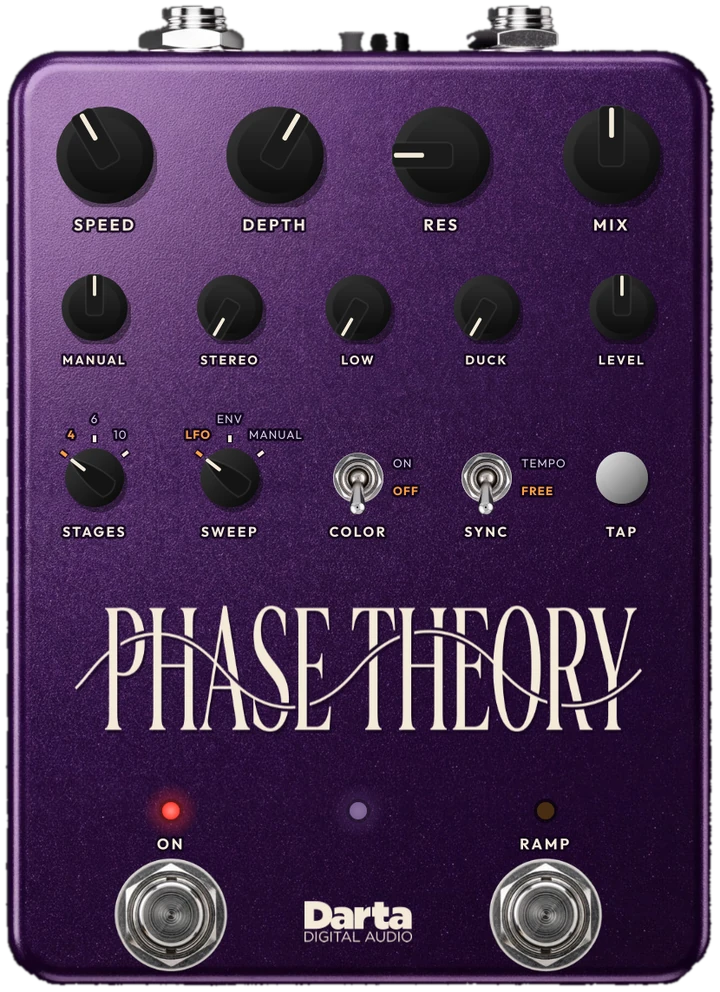
The theory of phase.
In the early 70s, phaser pedals tried to imitate the spin of a rotary speaker with a chain of electronic stages. Each stage delays part of the frequencies a little; added to the original sound, this cancels a few bands (the notches), and the LFO moves those notches up and down. The result is the sound that swirls and breathes, from funk to psychedelic rock. Phase Theory is Time Theory's sibling: one plays with time, the other with phase.
Real stages
Every stage is solved at the same instant as the others, feedback included, just as it happens in the circuit. The JFETs aren't identical and shift a little with the signal itself: the notches stay round and the sound gets the pedal's grit.
Resonance that sings
RES takes the feedback from subtle to vocal, without detuning or turning metallic. The COLOR switch adds the factory resonance of the boldest classic pedals.
Built to play
Sweep by the LFO, by your picking (ENV) or parked with MANUAL, LOW to keep the low end clean, DUCK, stereo, SYNC to your DAW, TAP and RAMP, which speeds up like a rotary speaker.
The controls
Four big knobs, five small knobs, two selectors, two switches, TAP and two footswitches. All of them can be automated in your DAW.
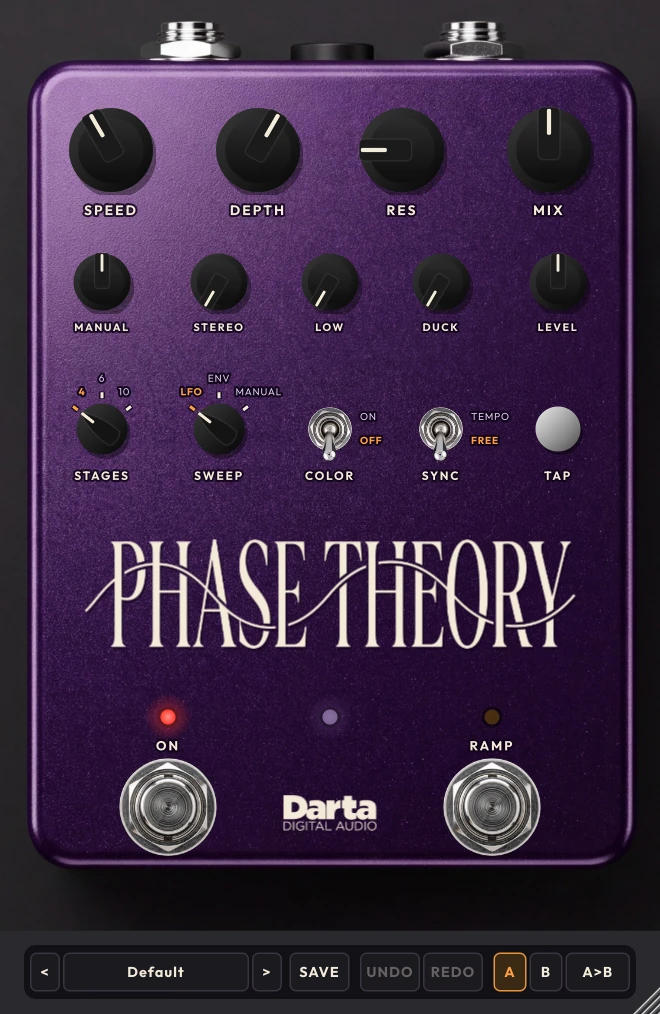
SPEED
The speed, from 0.05 to 10 Hz. With SYNC on, it picks a note value (from 2 bars to 1/32). In ENV, it’s how long the sweep takes to fall back (800 to 60 ms).
DEPTH
How wide the sweep is, up to two octaves each side of MANUAL. In ENV, how far your picking pushes it.
RES
The resonance. Turn it up and the peaks between the notches get more vocal, until the sound sings.
MIX
At 5, half and half like the pedals: the deepest notches, at the same level as your guitar. At 10, only the effected sound, which becomes a vibrato.
MANUAL
The center of the sweep, from 180 Hz to 3.6 kHz. In MANUAL mode, the fixed position, like a parked wah.
STEREO
Offsets the right side’s sweep by up to 180 degrees: the sound swirls between the speakers. At 0, both sides together.
LOW
Below this frequency (40 to 400 Hz) the sound passes clean: your bass and low strings stay solid. At 0, off.
DUCK
The effect backs off while you play and comes in as the note rings.
LEVEL
At 5, the same level as your bypassed guitar; up to +8 dB.
STAGES
4 (two notches, the classic), 6 (three) or 10 (five, the jet). Click a number to choose it.
SWEEP
LFO: continuous movement. ENV: the sweep follows how hard you pick. MANUAL: parked where the MANUAL knob is.
COLOR
ON: adds the factory resonance, like the boldest classic pedals. OFF: the smooth sound. RES adjusts on top of it.
SYNC
TEMPO: SPEED follows your DAW’s tempo. FREE: free-running speed.
TAP
Click in time, twice or more: each click is one turn of the sweep. Turns SYNC off.
ON
Turns the pedal on and off, with no click. Red LED. The middle LED follows the LFO, or your picking in ENV.
RAMP
Step on it and the phaser spins up to fast, like a rotary speaker’s motor; step again and it slows down gently. Amber LED.
The stages
The STAGES selector sets how many notches move through your sound.
4
Two notches: the phaser of the 70s pedals, the smooth swirl that brings the guitar to life without thinning it out.
Great forFunk, classic rock, leads, electric pianos.6
Three notches: the movement gets denser and more vocal, especially with a little RES.
Great forLeads, clean arpeggios, synths.10
Five notches close together: with RES and COLOR, the sound becomes a jet, close to a flanger.
Great forPsychedelia, ambient, effects, drums.Three ways to sweep
The SWEEP selector decides what moves the notches.
LFO
The continuous movement of the pedals, with an almost triangular LFO with rounded tips, as in the circuit. With SYNC, it stays in time with the song.
ENV
Your picking is in charge: play hard and the sweep rises; as the note fades, it falls back at the SPEED time. The phaser’s auto-wah, great for funk.
MANUAL
The notches stay where the MANUAL knob puts them: a fixed filter, like a parked wah, that gives the guitar a voice.
16 presets to start with
In four categories. And you can save your own with SAVE, compare two settings with A and B, and undo with UNDO.
Classic · 5
Six Stage · 3
Jet · 3
Special · 5
Tips to get the most out of it
Ideas to get started.
The 70s classic
STAGES on 4, SPEED around 4, RES on 2 and COLOR off: the smooth swirl of the pedals.
Factory bite
Turn COLOR on and bring SPEED up to around 5: the phaser gets bolder and cuts through the mix.
Funk in your picking
SWEEP on ENV, MANUAL on 3, DEPTH on 8 and RES on 6: every pick stroke opens up the sound.
Parked wah
SWEEP on MANUAL, MANUAL around 6.5, RES on 8 and COLOR on: the guitar gets a fixed, nasal voice.
Jet
STAGES on 10, SPEED on 1, DEPTH on 9, RES on 8 and COLOR on: the sound slowly takes off.
Phaser on bass
LOW between 100 and 150 Hz: the phaser shows up in the mids and the low end stays solid.
Before or after the drive
Before the distortion, the sweep pushes the drive and gets more dramatic; after it, the phaser stays clearer and wider.
Phase vibrato
MIX on 10, SPEED around 6.5 and DEPTH on 5: only the effected sound, which wobbles the pitch.
Under the hood
No delay in the loop
The stages and the feedback are solved at the same instant, as in the circuit: the resonance rises without detuning or sounding metallic.
Real JFETs
Each stage's resistance shifts a little with the signal itself, and the stages aren't identical: the same grit and the round notches of the pedal.
Always the same volume
The level was measured across every combination of MIX, RES, COLOR and STAGES: the sound stays at your bypassed guitar's level, so you can compare by ear without loudness fooling you.
Standalone
It also opens as an app, to play without a DAW.
Try before you buy
Download the trial with everything unlocked: every control, all 16 presets and the standalone app with amp and cabinet. The only difference is that the sound drops out for 3 seconds every 45 seconds and presets can’t be saved. Like it? Buy a license and paste the key into the plugin, no reinstall needed.
Windows 10 and 11 (VST3 and standalone) and macOS 10.15 or newer (AU, VST3 and standalone).
Specifications
System
Windows 10 or 11, 64-bit. macOS 10.15 or newer (Intel and Apple Silicon).
Formats
Windows: VST3 and standalone application. Mac: AU, VST3 and standalone application.
License
One license key activates up to 2 computers. Once activated, it works offline.
Output
Stereo. A mono guitar becomes stereo with STEREO.
Latency
Zero: the sound comes out instantly.
FAQ
Which pedal is it based on?
On the analog phasers of the 70s, like the Phase 90 and the Small Stone. Phase 90 is a trademark of MXR/Dunlop and Small Stone of Electro-Harmonix; Darta is not affiliated with them and the names are used here only to describe the style of sound.
What does the COLOR switch do?
It adds the factory feedback: the phaser gets bolder, with more vocal peaks. It’s the difference between the smoother and the bolder versions of the classic pedals. RES adjusts the resonance on top of it.
Does it work on bass?
Very well. Set LOW between 100 and 150 Hz so the low end stays clean.
Does it follow my DAW's tempo?
It does. With SYNC on TEMPO, SPEED picks a note value and the movement stays in time with the song. You can also tap the tempo with TAP.
Is there latency?
No. Phase Theory adds no latency.
Is there a Mac version?
Yes. PHASE THEORY runs natively on Apple Silicon and Intel Macs, macOS 10.15 or newer, as AU, VST3 and standalone.
Do I need internet to use it?
Only to activate it. After that, PHASE THEORY works offline.
Can I use it on more than one computer?
Yes, each license key activates up to 2 computers. To move it, deactivate it on the old computer from inside the plugin.
How do I get the plugin?
Right after payment, you get the download link and your license key by e-mail. Both are also in My account.
What currency will I be charged in?
Darta is based in Brazil, so checkout is in Brazilian Reais (BRL): the US$ 19 price is converted at the day’s exchange rate. PayPal or your card issuer converts it back automatically and shows the exact amount in your currency before you confirm. Depending on their conversion rate, the final amount may differ slightly from US$ 19.
Can I play without a DAW?
Yes. The standalone app comes with a clean amp (VOLUME, BASS, MIDDLE and TREBLE) and a 1×12 cabinet, or your own IR. Just plug your guitar into your audio interface and play. In your DAW, the plugin is just the pedal, so you can use any amp and cabinet you like.
Is there a trial version?
Yes. Leave your e-mail under Try before you buy and download it right away. Everything works; the sound just drops out for 3 seconds every 45 seconds and presets can’t be saved. Once you buy, just paste the key into the plugin.
The theory of phase.
Charged in Brazilian Reais (BRL), converted from US$ 19 at the day’s exchange rate. PayPal or your card converts it back and shows the exact amount in your currency before you confirm. Download link and license key by e-mail right after payment.