
DARTA DIGITAL AUDIO · HIGH-GAIN DRIVE PLUGIN

The preamp of a 90s high-gain solid-state amp, in a pedal with four dual op-amps and two zener clipping stages. Plus four mods of our own: TIGHT, SHIFT, PRESENCE and a 9 or 18 V switch.
Charged in Brazilian Reais (BRL), converted from US$ 19 at the day’s exchange rate. PayPal or your card converts it back and shows the exact amount in your currency before you confirm. Download link and license key by e-mail right after payment. Windows and Mac.
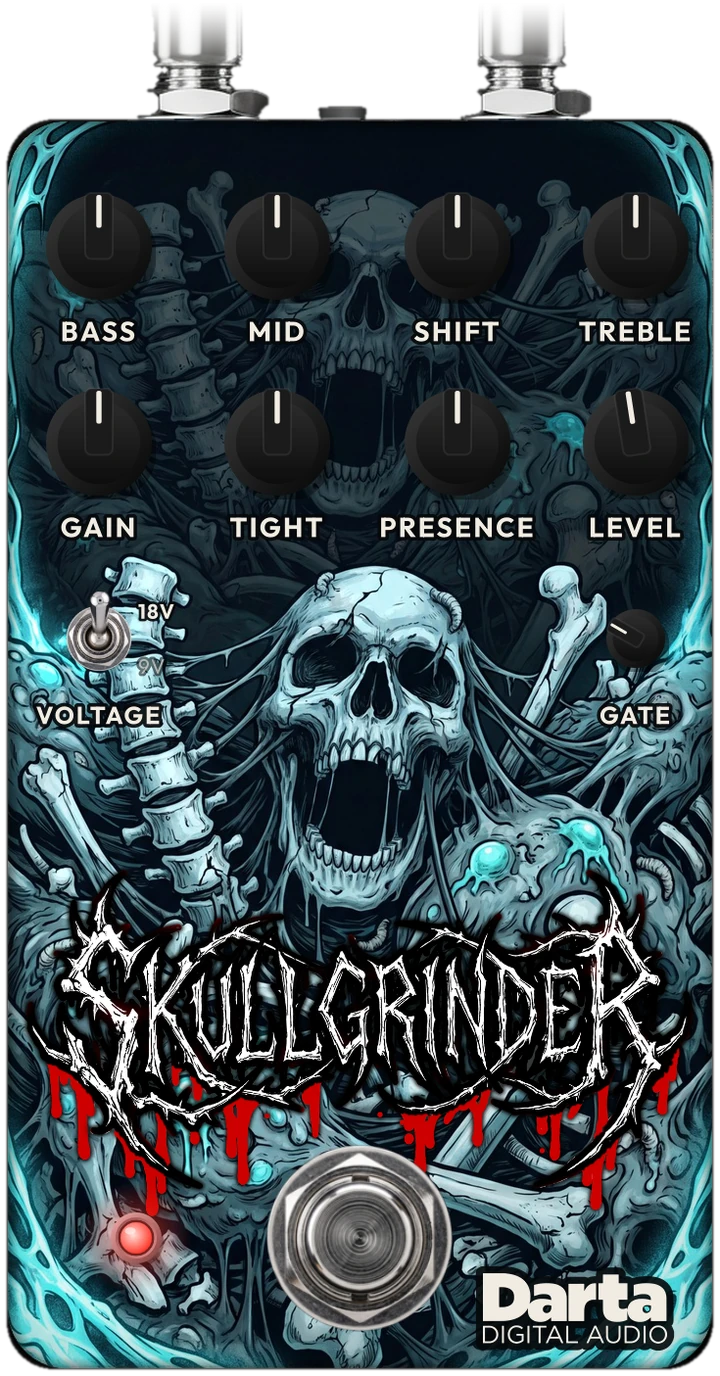
Rotten, heavy and sharp.
In the early 90s, the most extreme metal was recorded through high-gain solid-state amps: a raw sound, with aggressive mids and a crushing low end. The SKULLGRINDER circuit goes after that preamp with cascaded op-amps and zener pairs in the feedback. The plugin models the circuit with the schematic's values, part by part, and adds four controls the original doesn't have.
Two zener stages
Two op-amps saturate one after the other against different zener pairs: an asymmetric clipping that changes with how hard you pick.
Four mods
TIGHT tightens the lows before the distortion, SHIFT moves the MID frequency, PRESENCE adds sparkle after it and the switch picks 9 or 18 V.
9 V or 18 V
At the same volume: at 9 V the op-amps hit their limit sooner and the sound compresses; at 18 V there's headroom and the sound opens up.
The controls
Nine knobs, one switch and one footswitch. All of them can be automated in your DAW.
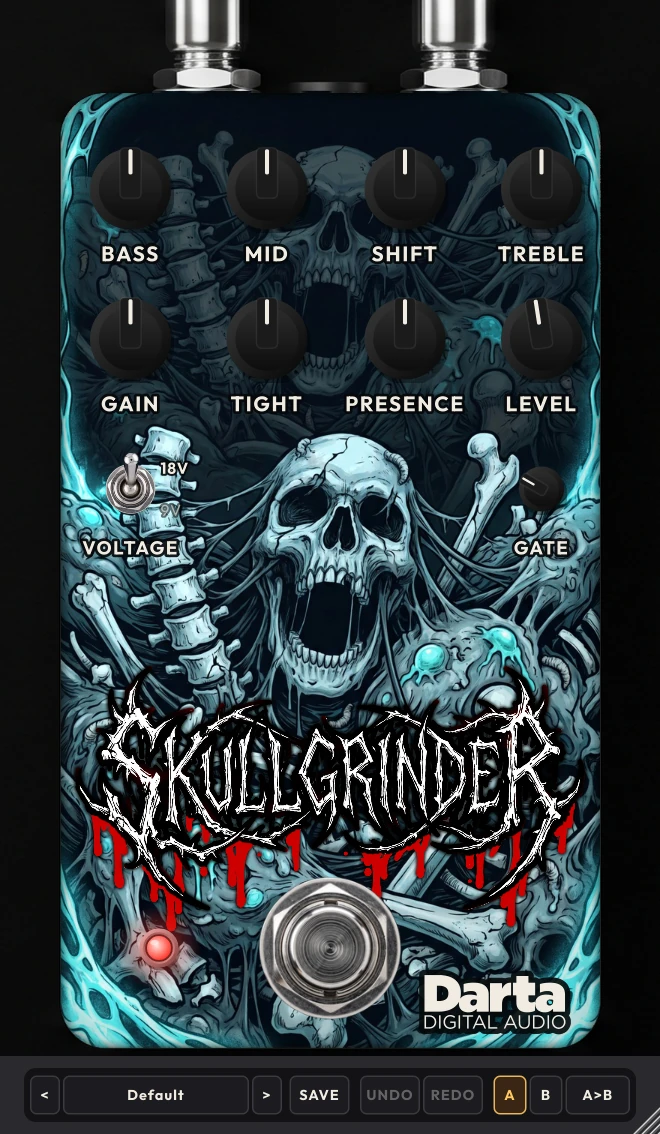
GAIN
The gain of both clipping stages. At low settings a crunch is left, at a much lower volume; from there up, the sound thickens up to full gain at 10.
BASS
The lows, after the distortion. High, the low end crushes; low, the sound gets drier.
MID
An adjustable dip in the mids. At 0 the mids are deeply scooped; at 10 the dip is shallow and the sound gets body and cuts through the mix.
SHIFT
Moves the MID frequency: around 400 Hz at 0, 1 kHz at 5 and 2.5 kHz at 10. It only matters with MID below max.
TREBLE
The highs, after the distortion. High, the sound gets raw and cutting; low, darker.
TIGHT
Cuts the lows BEFORE the distortion. At 10, it takes about 15 dB off at 40 Hz: palm mutes get dry and the low end doesn’t get muddy. At 0, the full low end of the original circuit.
PRESENCE
Sparkle at the end of the chain: from about +0.7 dB at 0 up to +7 dB at 10 kHz at 10.
LEVEL
The pedal’s volume. At 3 it matches the level of the guitar with the pedal off; above that, up to +24 dB.
VOLTAGE
Switch. 9 V: the original supply, the op-amps hit their limit sooner and the sound compresses. 18 V: more headroom, the zeners do the clipping and the sound opens up. Same volume on both.
GATE
Closes in the pauses. It listens to the clean guitar, before the pedal, so it doesn’t eat the end of your notes. At 0 it is off.
FOOTSWITCH
ON turns the pedal on with no click. The LED next to it lights up when it’s on.
Inside the circuit
The signal path, recreated with the op-amps and the zeners, in the same order.
INPUT
Zeners protect the input and two op-amps give the first gain, stronger in the upper mids. TIGHT comes in here and removes the lows before they reach the distortion.
Great forThe attack and the tight low end.CLIPPING
Two inverting op-amps saturate against pairs of 3.3 V and 6.8 V zeners. A diode with a capacitor shifts the operating point with the signal, so the clipping breathes with your picking.
Great forThe raw, asymmetric distortion.TONE
A T-filter makes the MID dip, at the SHIFT frequency. Then come TREBLE, BASS, PRESENCE and the output.
Great forThe final tone.The four mods
They're not in the original circuit: they're our own design, made for today's metal. All of them switch with no click while you play.
TIGHT
An adjustable low cut at the input, before the clipping. Great for low tunings and fast palm-muted riffs. Try the Tight Rhythm and Thrash Riff presets.
SHIFT
Moves the MID dip between 400 Hz and 2.5 kHz. Lower, the low end stays full and the attack comes through; higher, the sound gets nasal and cutting. Try the Scooped Chug and Cutting Lead presets.
PRESENCE
Sparkle after the distortion, without touching the gain. Great for cutting through the mix with TREBLE lower. Try the Bright Crunch preset.
9 V / 18 V
At 9 V the peaks sit about 1.3 dB lower against the average: the sound compresses. At 18 V it opens up, with more dynamics. Try the Classic Crunch and Smooth Lead presets, at 9 V.
16 presets to start with
In four categories, all at the same volume. And you can save your own with SAVE, compare two settings with A and B, and undo with UNDO.
Crunch · 4
Rhythm · 4
Lead · 4
Special · 4
Tips to get the most out of it
Ideas to get started.
Start at 3
With LEVEL at 3, switching the pedal on and off doesn’t change the volume, so you judge the sound, not the loudness.
In front of a clean sound
Use a clean amp or a clean channel in your amp sim; straight into a 4×12 cab IR also works great.
A tight low end
Low tuning? Bring TIGHT up to 7 or 8 and GATE to 5. Try the Tight Rhythm preset.
Scooped mids
GAIN at 8, BASS at 7, MID at 1, SHIFT at 4, TREBLE at 7. Try the Scooped Chug preset.
A singing solo
GAIN at 9, MID at 8 and SHIFT at 4. Try the Singing Lead preset.
More compression
Flip the switch to 9 V: the same setting gets more compressed and smoother, at the same volume.
Under the hood
Checked against circuit simulation
The circuit was compared with SPICE, the circuit simulator engineers use: the frequency response matches within 0.06 dB up to 10 kHz and, with distortion, the output stays within 0.8%.
Real op-amps and zeners
Each op-amp follows a model with its bandwidth, its speed (slew rate) and the supply limit; the zeners and diodes follow the parts' curves. Everything is solved together, at every sample.
With the schematic's values
Every resistor and capacitor of the original circuit. The mods use values we chose and checked in the same simulation.
16x oversampling
The distortion runs at 16x your DAW's rate, so the highs stay clean even with GAIN maxed out.
Try before you buy
Download the trial with everything unlocked: every control, all 16 presets and the standalone app with amp and cabinet. The only difference is that the sound drops out for 3 seconds every 45 seconds and presets can’t be saved. Like it? Buy a license and paste the key into the plugin, no reinstall needed.
Windows 10 and 11 (VST3 and standalone) and macOS 10.15 or newer (AU, VST3 and standalone).
Specifications
System
Windows 10 or 11, 64-bit. macOS 10.15 or newer (Intel and Apple Silicon).
Formats
Windows: VST3 and standalone application. Mac: AU, VST3 and standalone application.
License
One license key activates up to 2 computers. Once activated, it works offline.
Controls
Gain, Bass, Mid, Shift, Treble, Tight, Presence, Level, Gate, the Voltage switch (9 / 18 V) and the On footswitch.
Channels
Mono or stereo. A mono guitar comes out on both sides.
FAQ
Which gear is it based on?
On a pedal circuit inspired by the preamp of the Ampeg VH-140C, a 90s high-gain solid-state amp. TIGHT, SHIFT, PRESENCE and the 9/18 V switch are our own mods. Ampeg and VH-140C are trademarks of their respective owners; Darta is not affiliated with them and the names are used here only to describe the style of sound.
Does it have a clean sound?
No: it’s a high-gain drive. For the least gain, keep GAIN low (try the Gentle Drive preset) and roll back your guitar’s volume.
Does the 9/18 V switch change the volume?
No: both positions were measured and come out at the same volume, so the switch changes the sound, not the loudness.
Is there latency?
Only 5 samples (about 0.1 ms at 48 kHz), because of the oversampling: imperceptible. The bypassed sound is delayed by the same amount, so switching on and off sounds seamless.
Is there a Mac version?
Yes. SKULLGRINDER runs natively on Apple Silicon and Intel Macs, macOS 10.15 or newer, as AU, VST3 and standalone.
Do I need internet to use it?
Only to activate it. After that, SKULLGRINDER works offline.
Can I use it on more than one computer?
Yes, each license key activates up to 2 computers. To move it, deactivate it on the old computer from inside the plugin.
How do I get the plugin?
Right after payment, you get the download link and your license key by e-mail. Both are also in My account.
What currency will I be charged in?
Darta is based in Brazil, so checkout is in Brazilian Reais (BRL): the US$ 19 price is converted at the day’s exchange rate. PayPal or your card issuer converts it back automatically and shows the exact amount in your currency before you confirm. Depending on their conversion rate, the final amount may differ slightly from US$ 19.
Can I play without a DAW?
Yes. The standalone app comes with a clean amp (VOLUME, BASS, MIDDLE and TREBLE) and a 1×12 cabinet, or your own IR. Just plug your guitar into your audio interface and play. In your DAW, the plugin is just the pedal, so you can use any amp and cabinet you like.
Is there a trial version?
Yes. Leave your e-mail under Try before you buy and download it right away. Everything works; the sound just drops out for 3 seconds every 45 seconds and presets can’t be saved. Once you buy, just paste the key into the plugin.
Rotten, heavy and sharp.
Charged in Brazilian Reais (BRL), converted from US$ 19 at the day’s exchange rate. PayPal or your card converts it back and shows the exact amount in your currency before you confirm. Download link and license key by e-mail right after payment.