
DARTA DIGITAL AUDIO · FLANGER PLUGIN
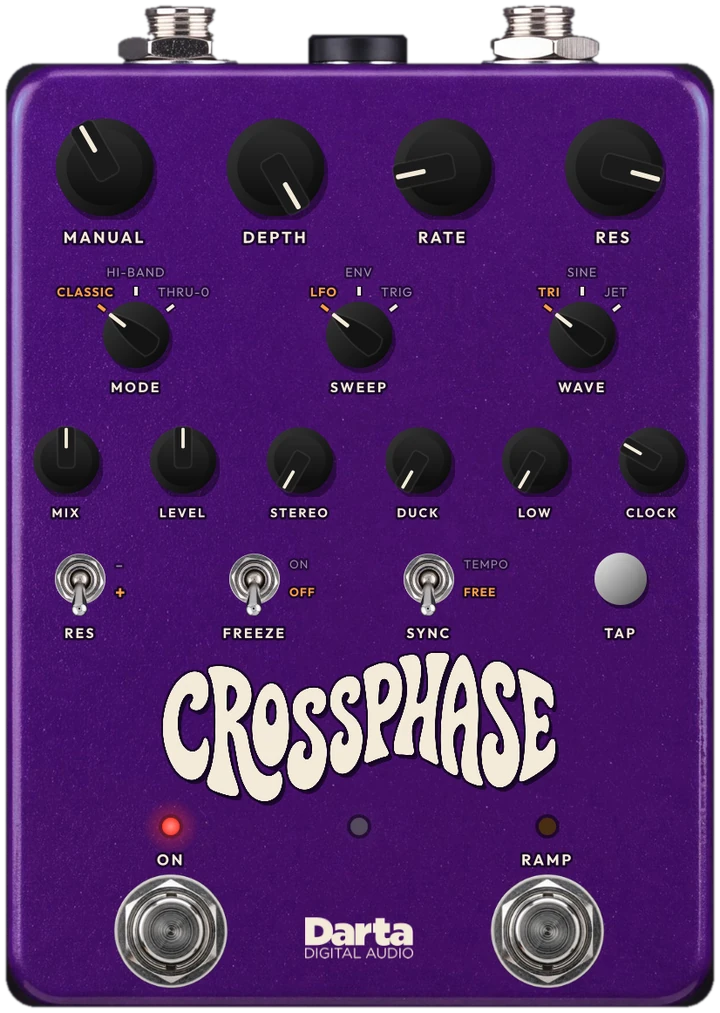
The jet sweep of the 70s and 80s analog flangers, with the delay chip truly modeled. Three flangers in one pedal (Classic, Hi-Band and Thru-Zero), and a sweep that can follow your picking, freeze, or take off under your foot.
Charged in Brazilian Reais (BRL), converted from US$ 19 at the day’s exchange rate. PayPal or your card converts it back and shows the exact amount in your currency before you confirm. Download link and license key by e-mail right after payment. Windows and Mac.
Two copies, one jet.
Flanging was born in 60s studios: two tape machines playing the same song, and the engineer slowing one down with a finger on the reel's flange. The two copies drifted in and out of phase, crossing each other. That's where the name Crossphase comes from. In pedals, an analog delay chip plays the part of the second tape, and that chip is what Crossphase recreates.
A real analog chip
Your sound runs through a modeled BBD, with its input and output filters and a clock that moves with the sweep. That's what gives you the jet shape of the classic pedals, the hiss that grows at long delays and the analog grit.
Three flangers in one
CLASSIC, the 1024-stage flanger; HI-BAND, the brighter 512-stage version that takes more resonance; and THRU-ZERO, the tape flanger, where the sound vanishes for an instant as the two copies cross.
Way beyond an LFO
The sweep can follow how hard you pick, fire a jet on every note, freeze wherever you want or take off under your foot. Plus DUCK, LOW to keep the low end clean, stereo and TAP.
The controls
Four big knobs, three selectors, six small knobs, three switches, TAP and two footswitches. All of them can be automated in your DAW.
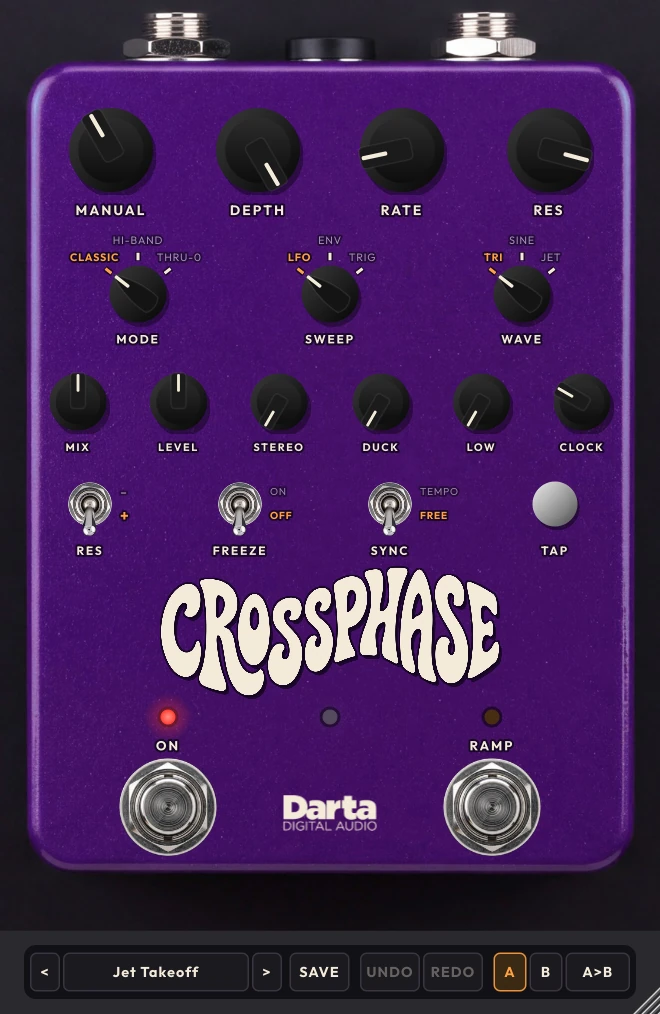
MANUAL
Where the sweep sits. Clockwise = shorter delay, higher notches.
DEPTH
How far the sweep goes around MANUAL.
RATE
The speed, from 0.05 to 10 Hz. With SYNC on, it picks a note value (from 2 bars to 1/32). In TRIG, it’s the length of each jet.
RES
Feedback. The higher, the more metallic and jet-like.
MODE
CLASSIC, HI-BAND or THRU-0 (thru-zero). Click a name to choose it.
SWEEP
What moves the filter: LFO (the wave), ENV (how hard you pick) or TRIG (one jet per note).
WAVE
The LFO shape: TRI (triangle, like the pedal), SINE (smoother) or JET (rises slowly, falls fast).
MIX
At 5, half and half like the pedal: the deepest notches. Lower = subtler.
LEVEL
At 5, the same level as your bypassed guitar; up to +8 dB.
STEREO
Offsets the right side’s sweep by up to 180 degrees: the jet flies from one speaker to the other.
DUCK
The effect backs off while you play and comes in as the note rings.
LOW
Below this frequency (40 to 400 Hz) the sound passes clean: your bass and low strings don’t go hollow. At 0, off.
CLOCK
The chip’s character. At 0, quiet; at 3, like a good pedal; at 10, dirty vintage with hiss and clock bleed.
RES − / +
Feedback polarity: + metallic and singing, − hollow and darker. In THRU-ZERO, − makes the sound cancel completely at the crossing point.
FREEZE
Freezes the filter exactly at MANUAL, and MANUAL becomes a hand-controlled sweep, like an expression pedal.
SYNC
TEMPO: RATE follows your DAW’s tempo. FREE: free-running rate.
TAP
Tap twice or more in time with the song: each tap becomes one sweep.
ON
Turns the pedal on and off, with no click. Red LED. The middle LED glows with the sweep.
RAMP
Step on it and the flanger speeds up to fast in about 1.5 s, like a jet taking off; step again and it slows down gently. Amber LED.
The three modes
The MODE selector picks the chip and how the two copies cross.
CLASSIC
The 1024-stage flanger, with 1 to 9 ms of delay. It's the full, metallic sound of the classic pedals, from watery chorus to a full jet with RES up.
Great forClean and distorted guitar, rock, metal, open chords.HI-BAND
The 512-stage version: the notches sit one octave higher, the sound is brighter and touches the low note less. It takes more resonance without getting muddy.
Great forBass, funk, bright clean tones.THRU-ZERO
The dry sound also runs through a chip, at a fixed delay, and the wet one sweeps around it. When they cross, the sound vanishes for an instant and comes back: the effect from 60s and 70s records.
Great forDrums, mix bus, doubled guitars, psychedelia.What moves the filter
The SWEEP selector picks what drives the sweep.
LFO
The wave goes back and forth on its own, the classic way. Pick its shape with WAVE and its speed with RATE, TAP, or the song’s tempo with SYNC.
ENV
The filter follows how hard you pick: play hard and it rises, play soft and it falls. A flanger that answers your hand.
TRIG
Every note fires a jet, from top to bottom, lasting as long as RATE says. The effect follows your picking, not a clock.
18 presets to start with
In four categories. And you can save your own with SAVE, compare two settings with A and B, and undo with UNDO.
Classic · 6
Hi-Band · 3
Thru-Zero · 3
Special · 6
Tips to get the most out of it
Ideas to get started.
The classic jet
CLASSIC, MANUAL on 4, DEPTH on 10, a very slow RATE and RES on 8: the jet taking off, after a distortion.
Before or after the drive
Before the distortion, the flanger gets wilder and more metallic; after it, cleaner and more defined. Try both.
Bass
HI-BAND and LOW between 100 and 150 Hz: the flanger shows up in the mids and the low end stays solid.
Real tape
THRU-ZERO with RES on − and a slow RATE: the sound vanishes and comes back, like on psychedelic records.
Playing the filter
Turn on FREEZE, raise RES and turn MANUAL slowly while you play: you steer the jet by hand.
One jet per note
SWEEP on TRIG and high RES on single notes: every pick fires the sweep.
Leads that stay clear
DUCK on 7: while you play fast the flanger backs off; on long notes it blooms.
Takeoff
Slow RATE and RAMP: step on it in the chorus and the flanger spins up like a turbine.
Under the hood
Modeled BBD
The analog delay chip is simulated clock pulse by clock pulse, with its input and output filters, as in the circuit. Hiss and aliasing grow at long delays, like on a real pedal.
A sweeping clock
The LFO doesn't move a digital delay: it moves the clock frequency, through the pedal's VCO. That's why the sweep has the original's shape.
Thru-zero with two chips
In THRU-ZERO, the dry sound also runs through a chip at a fixed delay, and the wet one crosses it.
Standalone
It also opens as an app, to play without a DAW.
Try before you buy
Download the trial with everything unlocked: every control, all 18 presets and the standalone app with amp and cabinet. The only difference is that the sound drops out for 3 seconds every 45 seconds and presets can’t be saved. Like it? Buy a license and paste the key into the plugin, no reinstall needed.
Windows 10 and 11 (VST3 and standalone) and macOS 10.15 or newer (AU, VST3 and standalone).
Specifications
System
Windows 10 or 11, 64-bit. macOS 10.15 or newer (Intel and Apple Silicon).
Formats
Windows: VST3 and standalone application. Mac: AU, VST3 and standalone application.
License
One license key activates up to 2 computers. Once activated, it works offline.
Output
Stereo. A mono guitar becomes stereo with STEREO.
Latency
About 0.5 ms, reported to your DAW, which compensates automatically.
FAQ
Which pedal is it based on?
On the analog flangers of the 70s and 80s, like the BF-2 and HF-2. BF-2 and HF-2 are trademarks of Boss/Roland; Darta is not affiliated with them and the names are used here only to describe the style of sound.
What is thru-zero?
It’s the original tape flanging. In ordinary pedals, only the wet sound is delayed. In thru-zero, the dry sound is delayed too, and the wet one goes from shorter to longer than it: at the crossing point the two copies cancel and the sound vanishes for an instant.
Is it noisy?
A little, like an analog pedal, and only if you want it. CLOCK controls the hiss and clock bleed: at 0 it’s quiet.
Is there latency?
About 0.5 ms. Crossphase reports it to your DAW, which compensates automatically.
Does it work on bass?
Very well. Use HI-BAND and set LOW to 100 or 150 Hz so the low end stays clean.
Is there a Mac version?
Yes. CROSSPHASE runs natively on Apple Silicon and Intel Macs, macOS 10.15 or newer, as AU, VST3 and standalone.
Do I need internet to use it?
Only to activate it. After that, CROSSPHASE works offline.
Can I use it on more than one computer?
Yes, each license key activates up to 2 computers. To move it, deactivate it on the old computer from inside the plugin.
How do I get the plugin?
Right after payment, you get the download link and your license key by e-mail. Both are also in My account.
What currency will I be charged in?
Darta is based in Brazil, so checkout is in Brazilian Reais (BRL): the US$ 19 price is converted at the day’s exchange rate. PayPal or your card issuer converts it back automatically and shows the exact amount in your currency before you confirm. Depending on their conversion rate, the final amount may differ slightly from US$ 19.
Can I play without a DAW?
Yes. The standalone app comes with a clean amp (VOLUME, BASS, MIDDLE and TREBLE) and a 1×12 cabinet, or your own IR. Just plug your guitar into your audio interface and play. In your DAW, the plugin is just the pedal, so you can use any amp and cabinet you like.
Is there a trial version?
Yes. Leave your e-mail under Try before you buy and download it right away. Everything works; the sound just drops out for 3 seconds every 45 seconds and presets can’t be saved. Once you buy, just paste the key into the plugin.
Two copies, one jet.
Charged in Brazilian Reais (BRL), converted from US$ 19 at the day’s exchange rate. PayPal or your card converts it back and shows the exact amount in your currency before you confirm. Download link and license key by e-mail right after payment.