
DARTA DIGITAL AUDIO · DELAY PLUGIN

The warm echo of analog delay pedals, with the delay chip truly modeled. Three chips in one pedal (DM, Memory and Modern), modulation, rhythmic note values with TAP and SYNC, and a HOLD that pushes the repeats into oscillation.
Charged in Brazilian Reais (BRL), converted from US$ 19 at the day’s exchange rate. PayPal or your card converts it back and shows the exact amount in your currency before you confirm. Download link and license key by e-mail right after payment. Windows and Mac.
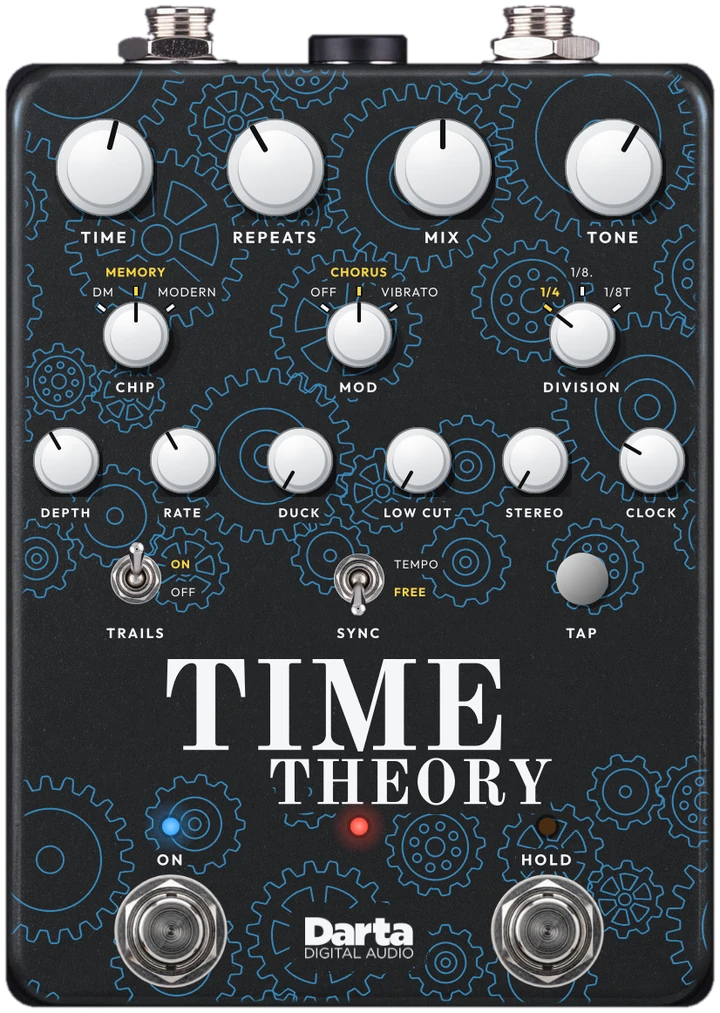
Time, carried in buckets.
Before digital delay, echo pedals carried your sound through a chip with thousands of tiny capacitors, the buckets, passing the signal from one to the next at the pace of a clock, like a bucket brigade. Each trip loses a little treble and adds some grit. That's why an analog echo gets darker and warmer with every repeat and sits behind the guitar instead of fighting it. Time Theory recreates that chip.
A real analog chip
Your sound runs through a modeled BBD, with its input and output filters. TIME moves the chip's clock, not a digital delay: turn TIME while you play and the repeats bend up and down in pitch, just like on the pedal.
Three delays in one
DM, the warm, dark compact; MEMORY, the full, long analog with a compander; and MODERN, the clean, bright analog with less hiss.
Built to play in time
TIME is the quarter note and DIVISION picks the echo's note value: quarter, dotted eighth or triplet. Plus TAP, SYNC to your DAW, HOLD to oscillate, TRAILS, DUCK and stereo all the way to ping-pong.
The controls
Four big knobs, three selectors, six small knobs, two switches, TAP and two footswitches. All of them can be automated in your DAW.
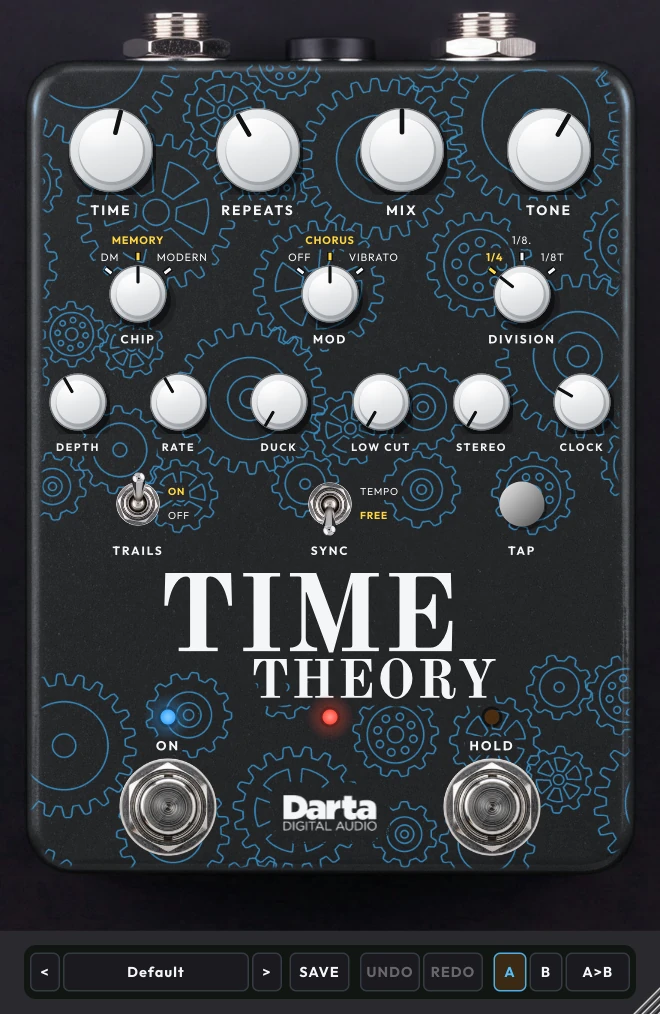
TIME
The quarter note, from 20 ms to 1 s. The echo is TIME times DIVISION’s note value. Turning it while you play bends the repeats up or down in pitch.
REPEATS
How many repeats. At 10 the delay self-oscillates, and the chip keeps the level from blowing up.
MIX
How loud the repeats are, up to the level of your dry sound. The dry sound always passes untouched.
TONE
At 0, dark, worn repeats; at 10, open ones. Each repeat comes out darker than the one before.
CHIP
DM, MEMORY or MODERN: the chip and the character of each pedal. Click a name to choose it.
MOD
OFF, CHORUS (a gentle sway on the repeats) or VIBRATO (deeper and faster, like warbling tape). Only the repeats move; the dry sound stays still.
DIVISION
The echo’s note value: 1/4 (quarter note, TIME itself), 1/8. (dotted eighth, 3/4 of TIME) or 1/8T (triplet, 1/3 of TIME).
DEPTH
How much the modulation moves the repeats.
RATE
The modulation speed, from 0.1 to 8 Hz.
DUCK
The repeats back off while you play and come up in the gaps.
LOW CUT
Takes low end out of the repeats (20 to 500 Hz), so the echo doesn’t muddy your notes.
STEREO
From mono to ping-pong: at 10, the echo bounces from one speaker to the other.
CLOCK
The chip’s character. At 0, quiet; at 3, like a good pedal; at 10, dirty vintage with hiss and clock bleed.
TRAILS
ON: when you switch the pedal off, the repeats fade out on their own. OFF: the echo cuts with it.
SYNC
TEMPO: the quarter note follows your DAW’s tempo. FREE: TIME is in charge.
TAP
Tap quarter notes, twice or more, in time with the song: TIME takes the tapped beat and DIVISION applies the note value. Turns SYNC off.
ON
Turns the pedal on and off, with no click. Blue LED. The red LED in the middle blinks with every repeat.
HOLD
While you hold it down, the repeats go all the way up and the echo builds into oscillation; let go and it settles back. A quick tap works as TAP. Amber LED.
The three chips
The CHIP selector picks the chip and the character of the echo.
DM
A single chip with low filters: the short, warm, dark echo of the 80s compact pedals. At long delays the chip works at its limit and the repeats get dirty, just like it did.
Great forSlapback, rockabilly, blues, short echoes.MEMORY
Chips in series plus a compander, like the big analog delays: long delays, a full echo and that breathing in the repeats, with the hiss tucked away in the gaps.
Great forLeads, ambience, long modulated echoes.MODERN
The same chips in series, with more open filters and less hiss: analog warmth with more defined repeats.
Great forClean tones, dotted eighths, mixing.Time theory
TIME is the quarter note. DIVISION picks the echo's note value.
DIVISION
1/4 repeats on the quarter note; 1/8. on the dotted eighth, the echo that fills the gaps between your picking; 1/8T on the triplet, with swing.
TAP
Tap the quarter note, even with DIVISION on 1/8. or 1/8T: the pedal does the math. The red LED then blinks in time with the echo.
SYNC
With SYNC on TEMPO, the quarter note comes from your DAW’s tempo: the echo stays in time with the song, even when the tempo changes.
16 presets to start with
In four categories. And you can save your own with SAVE, compare two settings with A and B, and undo with UNDO.
Classic · 5
Rhythm · 4
Ambient · 3
Special · 4
Tips to get the most out of it
Ideas to get started.
Slapback
DM, TIME around 95 ms, REPEATS on 1 and MIX on 6: the short echo of rockabilly and country.
Dotted eighth
DIVISION on 1/8., TAP the song’s quarter note and STEREO on 10: the repeats fill the gaps between your picking.
Oscillation by hand
Hold HOLD down and turn TIME: the echo becomes a spaceship taking off. Let go and it settles back.
Echoes that stay clear
LOW CUT between 4 and 5 and DUCK on 6: the repeats sit behind the guitar and come up in the pauses.
Ambience
MEMORY, TIME between 600 and 900 ms, REPEATS on 7 and MOD on a slow VIBRATO: a backdrop that breathes.
Worn-out tape
CLOCK on 10 and TONE on 3: the dirty, dark echo of an old pedal.
End of a solo
Leave TRAILS ON and switch the pedal off on the last note: the repeats die away naturally.
Before or after the drive
After the distortion, the echo stays clean and defined; before it, the repeats get distorted and gritty too. Try both.
Under the hood
Modeled BBD
The analog delay chip is simulated clock pulse by clock pulse, with its input and output filters, as in the circuit. At long delays the clock drops, the echo darkens and gains hiss, like on a real pedal.
TIME moves the clock
Changing TIME doesn't jump from one delay to another: the clock speeds up or slows down, and the repeats already inside the chip bend in pitch on the way.
Compander
On MEMORY and MODERN, a compressor before the chip and an expander after it, like the big analog delays: less hiss in the gaps and the breathing of the repeats.
Standalone
It also opens as an app, to play without a DAW.
Try before you buy
Download the trial with everything unlocked: every control, all 16 presets and the standalone app with amp and cabinet. The only difference is that the sound drops out for 3 seconds every 45 seconds and presets can’t be saved. Like it? Buy a license and paste the key into the plugin, no reinstall needed.
Windows 10 and 11 (VST3 and standalone) and macOS 10.15 or newer (AU, VST3 and standalone).
Specifications
System
Windows 10 or 11, 64-bit. macOS 10.15 or newer (Intel and Apple Silicon).
Formats
Windows: VST3 and standalone application. Mac: AU, VST3 and standalone application.
License
One license key activates up to 2 computers. Once activated, it works offline.
Output
Stereo. A mono guitar becomes stereo with STEREO.
Latency
About 0.5 ms, reported to your DAW, which compensates automatically.
FAQ
Which pedal is it based on?
On analog delay pedals like the DM-2, the Carbon Copy and the Memory Man. DM-2 is a trademark of Boss/Roland, Carbon Copy of Dunlop/MXR and Memory Man of Electro-Harmonix; Darta is not affiliated with them and the names are used here only to describe the style of sound.
Is it noisy?
A little, like an analog pedal, and only if you want it. CLOCK controls the hiss and clock bleed: at 0 it’s quiet. On MEMORY and MODERN, the compander also tucks the hiss away in the gaps.
Does it self-oscillate?
It does. With REPEATS on 10 or HOLD held down, the echo builds on its own, and the chip keeps the level from blowing up.
Does it follow my DAW's tempo?
It does. With SYNC on TEMPO, the quarter note comes from your DAW, and DIVISION picks the note value.
Is there latency?
About 0.5 ms. Time Theory reports it to your DAW, which compensates automatically.
Is there a Mac version?
Yes. TIME THEORY runs natively on Apple Silicon and Intel Macs, macOS 10.15 or newer, as AU, VST3 and standalone.
Do I need internet to use it?
Only to activate it. After that, TIME THEORY works offline.
Can I use it on more than one computer?
Yes, each license key activates up to 2 computers. To move it, deactivate it on the old computer from inside the plugin.
How do I get the plugin?
Right after payment, you get the download link and your license key by e-mail. Both are also in My account.
What currency will I be charged in?
Darta is based in Brazil, so checkout is in Brazilian Reais (BRL): the US$ 19 price is converted at the day’s exchange rate. PayPal or your card issuer converts it back automatically and shows the exact amount in your currency before you confirm. Depending on their conversion rate, the final amount may differ slightly from US$ 19.
Can I play without a DAW?
Yes. The standalone app comes with a clean amp (VOLUME, BASS, MIDDLE and TREBLE) and a 1×12 cabinet, or your own IR. Just plug your guitar into your audio interface and play. In your DAW, the plugin is just the pedal, so you can use any amp and cabinet you like.
Is there a trial version?
Yes. Leave your e-mail under Try before you buy and download it right away. Everything works; the sound just drops out for 3 seconds every 45 seconds and presets can’t be saved. Once you buy, just paste the key into the plugin.
Time, carried in buckets.
Charged in Brazilian Reais (BRL), converted from US$ 19 at the day’s exchange rate. PayPal or your card converts it back and shows the exact amount in your currency before you confirm. Download link and license key by e-mail right after payment.