
DARTA DIGITAL AUDIO · OCTAVE FUZZ PLUGIN

A three-mode octave fuzz, modeled part by part from the original schematic: a transistor first stage that saturates hard, a rectifier that adds the upper octave and two output filters you pick with the MODE switch. Plus three Darta extras to take the sound past the original.
Charged in Brazilian Reais (BRL), converted from US$ 19 at the day’s exchange rate. PayPal or your card converts it back and shows the exact amount in your currency before you confirm. Download link and license key by e-mail right after payment. Windows and Mac.
An octave above the fuzz.
Some fuzzes don’t stop at fuzz: a pair of transistors rectifies the wave and brings out the upper octave, that metallic shimmer that sounds like a second instrument playing along. HYPERIUM models that circuit from the schematic values, part by part, and adds three controls that reach inside it. With all three at 5, you hear the original circuit.
Three fuzzes in one
The MODE switch picks the output filter: FUZZ I, open with scooped mids; FUZZ II, darker and smoother; or FUZZ I+II, both together.
The octave in your hands
OCTAVE goes from fuzz with no octave (0) to the upper octave even when you dig in hard (10). At 5, just like the original.
Shape and bias
SHAPE changes the filter before the fuzz, from dark to raspy; SPUTTER changes the bias of the octave transistors, from full to choked.
The controls
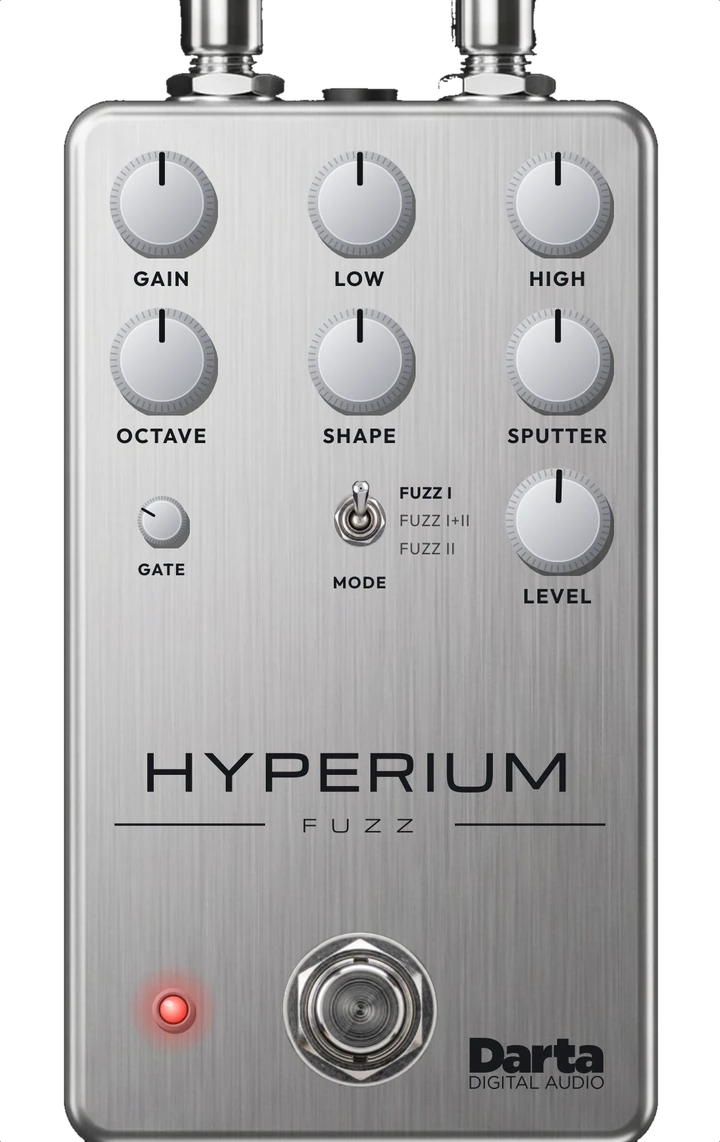
Eight knobs, a three-way switch and one footswitch. All of them can be automated in your DAW.

GAIN
The first stage gain, from about 2.5 to 36 times: the higher it goes, the harder the fuzz saturates.
LOW
Cuts or boosts the lows, around 100 Hz. At 5, flat.
HIGH
Cuts or boosts the highs, around 3 kHz. At 5, flat.
OCTAVE
How much of the upper octave comes through. At 0, fuzz with no octave; at 5, the original; at 7.5, octave when you play softly; at 10, octave even when you dig in.
SHAPE
The filter before the fuzz. At 0, dark and smooth; at 5, the original; at 10, raspy.
SPUTTER
The bias of the octave transistors. At 0, full; at 5, the original; at 10, starved and choked, cutting off the tail of the notes.
LEVEL
The pedal volume, in all three modes. At 3 it matches the guitar with the pedal off; above that you get up to +24 dB.
GATE
Closes in the pauses. It listens to the clean guitar, before the pedal, so it doesn’t eat the end of your notes. At 0 it’s off.
MODE
Picks the output filter: FUZZ I, FUZZ I+II or FUZZ II.
FOOTSWITCH
ON turns the pedal on without a click (red LED).
MODE: three fuzzes
After the octave, the signal goes through one of two output filters, or through both together.
Open
A T filter scoops the mids and leaves lows and highs around them: the raspiest fuzz, with the most audible octave.
Great forRiffs with attack and solos that cut.Both
Both filters together: the body of FUZZ II with the bite of FUZZ I. The fullest of the three.
Great forWalls of fuzz and heavy rhythm parts.Dark
A low-pass trims the highs: a smoother, thicker fuzz, with the octave further back.
Great forSinging leads and vintage tones.16 presets to start with
In four categories. And you can save your own with the SAVE button, compare two settings with A and B, and undo with UNDO.
Fuzz I · 4
Fuzz II · 4
Fuzz I+II · 4
Special · 4
Tips to get the most out of it
Ideas to get you started.
Start at 3
With LEVEL at 3, switching the pedal on and off doesn’t change the volume: you judge the sound, not the loudness.
In front of a clean sound
It’s made for the input of a clean amp. In an amp simulator, pick a clean channel; straight into a cabinet IR works too.
The octave lives up high
The upper octave is clearest high on the neck and on the bridge pickup. Play above the 12th fret and listen. Try the Octave Lead preset.
Octave always on
OCTAVE at 10: the octave shows up even when you dig in. Try the Octave Up preset.
Fuzz with no octave
OCTAVE at 0 and SHAPE at 0: a smooth, velvety fuzz without the octave shimmer. Try the Velvet Fuzz preset.
Choked on purpose
SPUTTER at 9: the octave transistors starve and notes die in pieces. Try the Sputter preset.
Under the hood
Checked against circuit simulation
Every part of the circuit was compared with SPICE, the engineers’ circuit simulator, with the same parts and the same models.
Real transistors and op-amps
The JFETs, transistors and diodes follow the parts’ curves, solved every sample; the op-amps have real bandwidth, speed and voltage limits.
The octave, as in the circuit
The octave comes from a pair of transistors rectifying the wave, just like in the pedal, not from a pitch effect: it reacts to your picking.
16x oversampling
The fuzz runs at 16x your DAW’s rate, so the highs stay clean.
Try before you buy
Download the trial with everything unlocked: every control, all 16 presets and the standalone app with amp and cabinet. The only difference is that the sound drops out for 3 seconds every 45 seconds and presets can’t be saved. Like it? Buy a license and paste the key into the plugin, no reinstall needed.
Windows 10 and 11 (VST3 and standalone) and macOS 10.15 or newer (AU, VST3 and standalone).
Specifications
System
Windows 10 or 11, 64-bit. macOS 10.15 or newer (Intel and Apple Silicon).
Formats
Windows: VST3 and standalone application. Mac: AU, VST3 and standalone application.
License
One license key activates up to 2 computers. Once activated, it works offline.
Controls
Gain, Low, High, Octave, Shape, Sputter, Level, Gate, Mode (Fuzz I, Fuzz I+II, Fuzz II) and the On footswitch.
Channels
Mono or stereo. A mono guitar comes out on both sides.
FAQ
Which pedal is it based on?
On a three-mode octave fuzz, modeled from the original schematic, part by part. The OCTAVE, SHAPE and SPUTTER controls are Darta extras: with all three at 5, the circuit matches the original.
Is the octave a pitch effect?
No. It’s born in the circuit, from a pair of transistors that rectify the wave, just like in the pedal. That’s why it changes with your picking, the fret and the pickup.
Does it do clean?
No: it’s a fuzz. For less saturation, turn GAIN down and use FUZZ II.
Is there any latency?
Only 5 samples (about 0.1 ms at 48 kHz), because of the oversampling: inaudible. The bypassed sound is delayed the same way, so there’s no difference when you switch it on and off.
Is there a Mac version?
Yes. HYPERIUM runs natively on Apple Silicon and Intel Macs, macOS 10.15 or newer, as AU, VST3 and standalone.
Do I need internet to use it?
Only to activate it. After that, HYPERIUM works offline.
Can I use it on more than one computer?
Yes, each license key activates up to 2 computers. To move it, deactivate it on the old computer from inside the plugin.
How do I get the plugin?
Right after payment, you get the download link and your license key by e-mail. Both are also in My account.
What currency will I be charged in?
Darta is based in Brazil, so checkout is in Brazilian Reais (BRL): the US$ 19 price is converted at the day’s exchange rate. PayPal or your card issuer converts it back automatically and shows the exact amount in your currency before you confirm. Depending on their conversion rate, the final amount may differ slightly from US$ 19.
Can I play without a DAW?
Yes. The standalone app comes with a clean amp (VOLUME, BASS, MIDDLE and TREBLE) and a 1×12 cabinet, or your own IR. Just plug your guitar into your audio interface and play. In your DAW, the plugin is just the pedal, so you can use any amp and cabinet you like.
Is there a trial version?
Yes. Leave your e-mail under Try before you buy and download it right away. Everything works; the sound just drops out for 3 seconds every 45 seconds and presets can’t be saved. Once you buy, just paste the key into the plugin.
An octave above the fuzz.
Charged in Brazilian Reais (BRL), converted from US$ 19 at the day’s exchange rate. PayPal or your card converts it back and shows the exact amount in your currency before you confirm. Download link and license key by e-mail right after payment.