
DARTA DIGITAL AUDIO · JFET DOOM DISTORTION PLUGIN

A complete doom pedal, modeled part by part: two JFET channels always blended, like the channels of a tube amp jumped together, a transistor booster up front with its own footswitch, an amp-style EQ (BASS, MID and TREBLE), PRESENCE and DEEP, and two outputs: AMP and DIRECT. Plus GATE and TIGHT.
Charged in Brazilian Reais (BRL), converted from US$ 19 at the day’s exchange rate. PayPal or your card converts it back and shows the exact amount in your currency before you confirm. Download link and license key by e-mail right after payment. Windows and Mac.
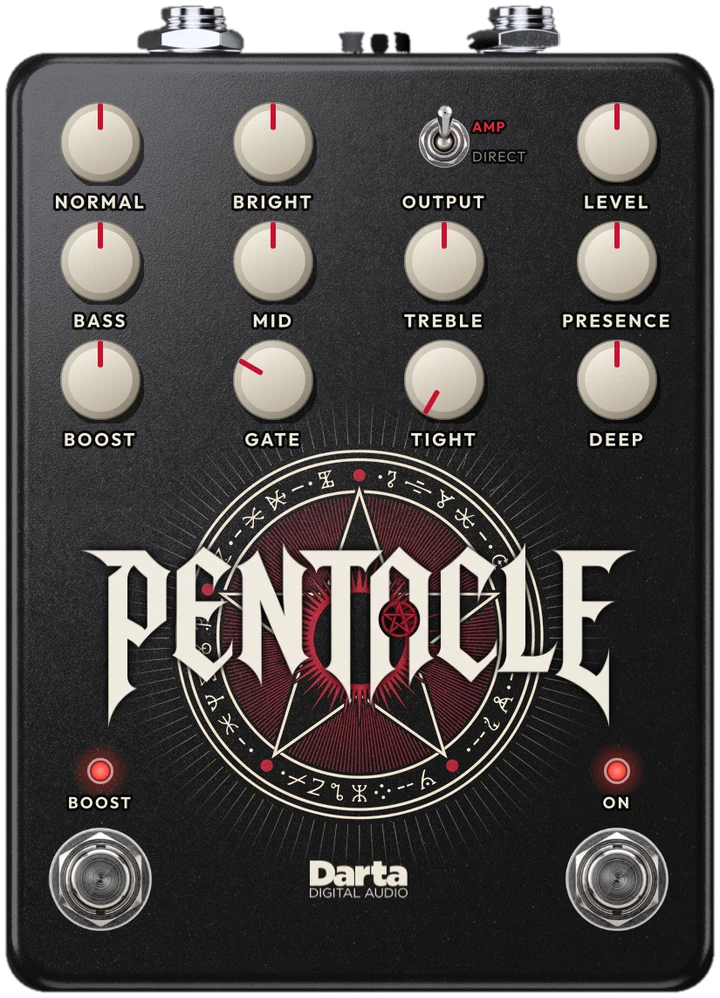
A doom amp, in a pedal.
A 1970s American tube amplifier became a legend in doom and stoner for its huge low end and thick saturation. It got a pedal version with JFETs in place of the tubes, a booster up front and the last stage of a German preamp. Pentacle models that circuit with the schematic's values, including the way the JFETs charge the capacitors when you dig in, and adds what it was missing for recording and playing on a computer: a gate that listens to the clean guitar and TIGHT for low tunings.
Two JFET channels
NORMAL, darker and thicker, and BRIGHT, with the highs passing straight through. Both are always on and blended: you set one against the other.
A booster up front
A one-transistor booster, with its own footswitch, pushes the JFETs by up to +26 dB: the sound gets thicker, sustains and breathes with your picking.
Two outputs
AMP to use before an amp or an amp sim; DIRECT to use it as a complete preamp, straight into a cab or an IR.
The controls
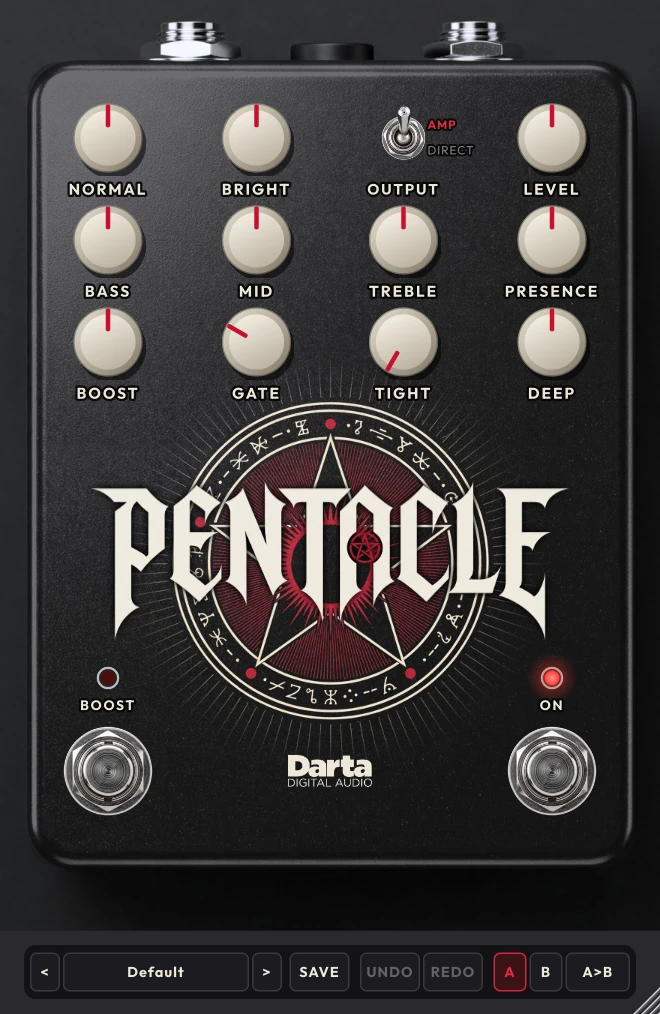
Eleven knobs, one switch and two footswitches. All of them can be automated in your DAW.
NORMAL
The volume of the normal channel, the darker and thicker one. Both channels always distort: NORMAL and BRIGHT set how much of each reaches the next stage, and how hard it saturates. At 0, the channel leaves the blend.
BRIGHT
The volume of the bright channel: the same JFET, with a capacitor that lets the highs pass straight through. More BRIGHT, more attack and definition.
OUTPUT
AMP is the output for the input of an amplifier or an amp sim, with the highs trimmed from around 2 kHz. DIRECT is the full-range output, for a power amp or a cab IR. Both have the same volume, so you can compare.
LEVEL
The pedal’s volume. At 3 it matches the level of the guitar with the pedal off; above that, up to +24 dB.
BASS, MID, TREBLE
The passive EQ after the distortion, like an amplifier’s: the three work together, and moving one changes the others. At 5, the starting point.
PRESENCE
Opens up the top end in the last stage: up to +11 dB at 2 kHz, on a shelf that starts around 250 Hz. At 0, off.
BOOST
The booster’s volume, switched by the BOOST footswitch: +13 dB at 2.5, +19 dB at 5 and up to +26 dB at 10. At 0 the booster is muted, like the volume of a real booster.
GATE
Closes in the pauses. It listens to the clean guitar, before the pedal, so it doesn’t eat the end of your notes. At 0 it is off.
TIGHT
Removes low end before everything (from 20 to 400 Hz): the lows stay firm in fast picking and low tunings. At 0, the original circuit.
DEEP
A resonant boost around 115 Hz: at 5, +4.5 dB; at 10, up to +25 dB, a deliberately exaggerated low-end punch. At 0, off.
FOOTSWITCHES
BOOST turns the booster on and ON turns the pedal on, both with no click. Each one has its own red LED.
The channels and the booster
The heart of Pentacle: two JFETs that distort together and a booster to push them both.
NORMAL
Lows and mids up front: the thick, dark sound of doom. On its own it's the heaviest; with BRIGHT, it gets an edge.
Great forSlow riffs, low tunings, chords that weigh a ton.BRIGHT
The highs pass straight through a capacitor: more attack and more definition on every picked note.
Great forLeads, riffs with single notes, cutting through the mix.BOOST
Pushes the JFETs into full saturation: more sustain, more compression and a sound that breathes with your picking, because the JFET gate current charges the circuit's capacitors.
Great forWalls of fuzz, drones and leads.AMP or DIRECT
The original circuit has both outputs, and Pentacle puts both on one switch.
AMP
The output for the front of an amplifier: with the highs trimmed from around 2 kHz, as the pedal intends. Use it before an amp sim.
DIRECT
The full-range output, for a power amp or an effects return: Pentacle becomes the whole preamp. Use it straight into a cab IR.
16 presets to start with
In four categories. And you can save your own with SAVE, compare two settings with A and B, and undo with UNDO.
Crunch · 4
Rhythm · 4
Lead · 4
Special · 4
Tips to get the most out of it
Ideas to get started.
Start at 3
With LEVEL at 3, switching the pedal on and off doesn’t change the volume, so you judge the sound, not the loudness.
The right output
Before an amp sim, use AMP. Straight into a cab IR, use DIRECT: AMP with no amp after it sounds muffled.
Blend the channels
Start with NORMAL and BRIGHT at 5. For more weight, raise NORMAL and lower BRIGHT; for more definition, the opposite.
The booster at the right time
BOOST at 6 and the BOOST footswitch only for the riff or the solo: the sound thickens and sustains when you need it.
Low tunings
TIGHT at 6, GATE at 6 and DEEP at 7: the lows stay firm and heavy, and the pauses stay dry.
Less saturation
NORMAL and BRIGHT between 1 and 3: the pedal saturates less and the notes come through. The Crunch presets are a good start.
Under the hood
Checked against circuit simulation
Each stage was compared with SPICE, the circuit simulator engineers use: the linear parts match within 0.02 dB and, with distortion, the waveform of every stage matches the simulator's.
Real JFETs
The four JFETs follow the part's curve, including gate conduction: that's what charges the capacitors between the stages and makes the sound breathe when you dig in. The booster saturates like the real transistor.
16x oversampling
The distortion runs at 16x your DAW's rate, so the highs stay clean.
Gate before the pedal
The gate listens to the clean guitar, before the pedal, and only closes what comes after it: notes end naturally.
Try before you buy
Download the trial with everything unlocked: every control, all 16 presets and the standalone app with amp and cabinet. The only difference is that the sound drops out for 3 seconds every 45 seconds and presets can’t be saved. Like it? Buy a license and paste the key into the plugin, no reinstall needed.
Windows 10 and 11 (VST3 and standalone) and macOS 10.15 or newer (AU, VST3 and standalone).
Specifications
System
Windows 10 or 11, 64-bit. macOS 10.15 or newer (Intel and Apple Silicon).
Formats
Windows: VST3 and standalone application. Mac: AU, VST3 and standalone application.
License
One license key activates up to 2 computers. Once activated, it works offline.
Controls
Normal, Bright, Output, Level, Bass, Mid, Treble, Presence, Boost, Gate, Tight, Deep and two footswitches (Boost and On).
Channels
Mono or stereo. A mono guitar comes out on both sides.
FAQ
Which gear is it based on?
On the Sunn Model T, a 1970s American tube amplifier widely used in doom and stoner, in its pedal version with JFETs in place of the tubes, with a booster up front and the last stage of the Diezel VH4. Sunn, Model T, Diezel and VH4 are trademarks of their respective owners; Darta is not affiliated with them and the names are used here only to describe the style of sound.
Does it have a clean sound?
No: it’s a distortion pedal from start to finish. With NORMAL and BRIGHT low it saturates less, into a thick crunch, but the input JFETs always color the sound.
Why is BOOST muted at 0?
Because the knob is the booster’s volume, like on a real booster. From 1 up it already adds gain; the default is 5, with +19 dB.
Should I use the AMP or the DIRECT output?
It depends on what comes next. Before an amplifier or an amp sim, use AMP. Straight into a cab IR, or into a power amp, use DIRECT. Both have the same volume.
Is there latency?
Only 5 samples (about 0.1 ms at 48 kHz), because of the oversampling: imperceptible. The bypassed sound is delayed by the same amount, so switching on and off sounds seamless.
Is there a Mac version?
Yes. PENTACLE runs natively on Apple Silicon and Intel Macs, macOS 10.15 or newer, as AU, VST3 and standalone.
Do I need internet to use it?
Only to activate it. After that, PENTACLE works offline.
Can I use it on more than one computer?
Yes, each license key activates up to 2 computers. To move it, deactivate it on the old computer from inside the plugin.
How do I get the plugin?
Right after payment, you get the download link and your license key by e-mail. Both are also in My account.
What currency will I be charged in?
Darta is based in Brazil, so checkout is in Brazilian Reais (BRL): the US$ 19 price is converted at the day’s exchange rate. PayPal or your card issuer converts it back automatically and shows the exact amount in your currency before you confirm. Depending on their conversion rate, the final amount may differ slightly from US$ 19.
Can I play without a DAW?
Yes. The standalone app comes with a clean amp (VOLUME, BASS, MIDDLE and TREBLE) and a 1×12 cabinet, or your own IR. Just plug your guitar into your audio interface and play. In your DAW, the plugin is just the pedal, so you can use any amp and cabinet you like.
Is there a trial version?
Yes. Leave your e-mail under Try before you buy and download it right away. Everything works; the sound just drops out for 3 seconds every 45 seconds and presets can’t be saved. Once you buy, just paste the key into the plugin.
A doom amp, in a pedal.
Charged in Brazilian Reais (BRL), converted from US$ 19 at the day’s exchange rate. PayPal or your card converts it back and shows the exact amount in your currency before you confirm. Download link and license key by e-mail right after payment.